
Tiny House on Wheels vs Foundation: Which Should You Choose?
Compare a tiny house on wheels with one on a foundation: codes, zoning, moving, utilities and site needs, plus the questions to ask your local office first.
 Save
A tiny house on wheels gives you mobility and often a simpler start, but fewer places where you can legally live in it full time. A tiny house on a foundation is usually treated like any other home, which can make zoning, financing and long-term use clearer, but it cannot be moved. The right choice depends mostly on your land, your local rules and how long you plan to stay.
This guide compares the two, explains how codes and standards treat each one, and gives you a short list of questions to ask before you spend money. Zoning and permit rules vary a lot between countries, states, counties and cities. This is general information, not legal advice, so confirm everything with your local planning and building offices.
Quick answer
Choose wheels if you want to relocate, want to test small living, or have a place that explicitly allows a wheeled home. Choose a foundation if you own land, want to stay long term, and want your home to fit into the standard residential process.
Many people start by asking which is cheaper. Costs depend on your design, your site and your local fees, so compare real quotes in your area rather than relying on general claims.
How codes treat each type
The building code and the zoning rules are two different things. Building codes address how a structure is built. Zoning and land use rules decide what can be built and where, and they are set mainly at the state and local level.
According to a white paper from the International Code Council (ICC), the International Residential Code (IRC) and its tiny house appendix do not care whether a tiny house sits on a foundation or on wheels. They focus on how the building is used. A permanently occupied dwelling generally falls under the IRC unless it meets the US federal manufactured housing standards.
Here is how the main standards fit together:
- IRC tiny house appendix: Appendix Q was added to the 2018 IRC to cover foundation-based housing under 400 square feet, and its scope now also covers movable tiny homes. The 2021 edition renamed it Appendix AQ. It only applies where your state or city has adopted it.
- HUD manufactured home standards (US): These apply to units built on a permanent chassis that are over 8 feet wide, over 40 feet long, or over 320 square feet.
- RV and park model standards: NFPA 1192 and ANSI A119.5 may apply to a unit meant only for temporary or seasonal use on a wheeled chassis. They focus on fire and life safety and plumbing. RVs are not intended as permanent residences.
Because adoption differs from place to place, the same tiny house can be treated very differently in two neighboring counties.
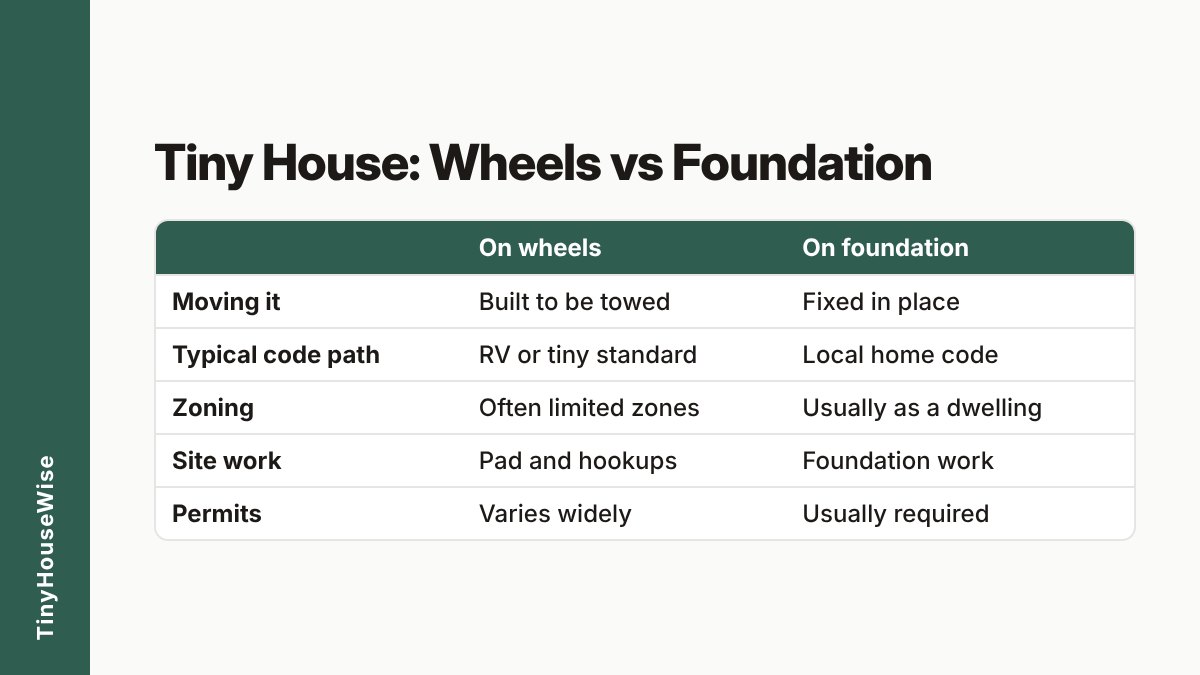
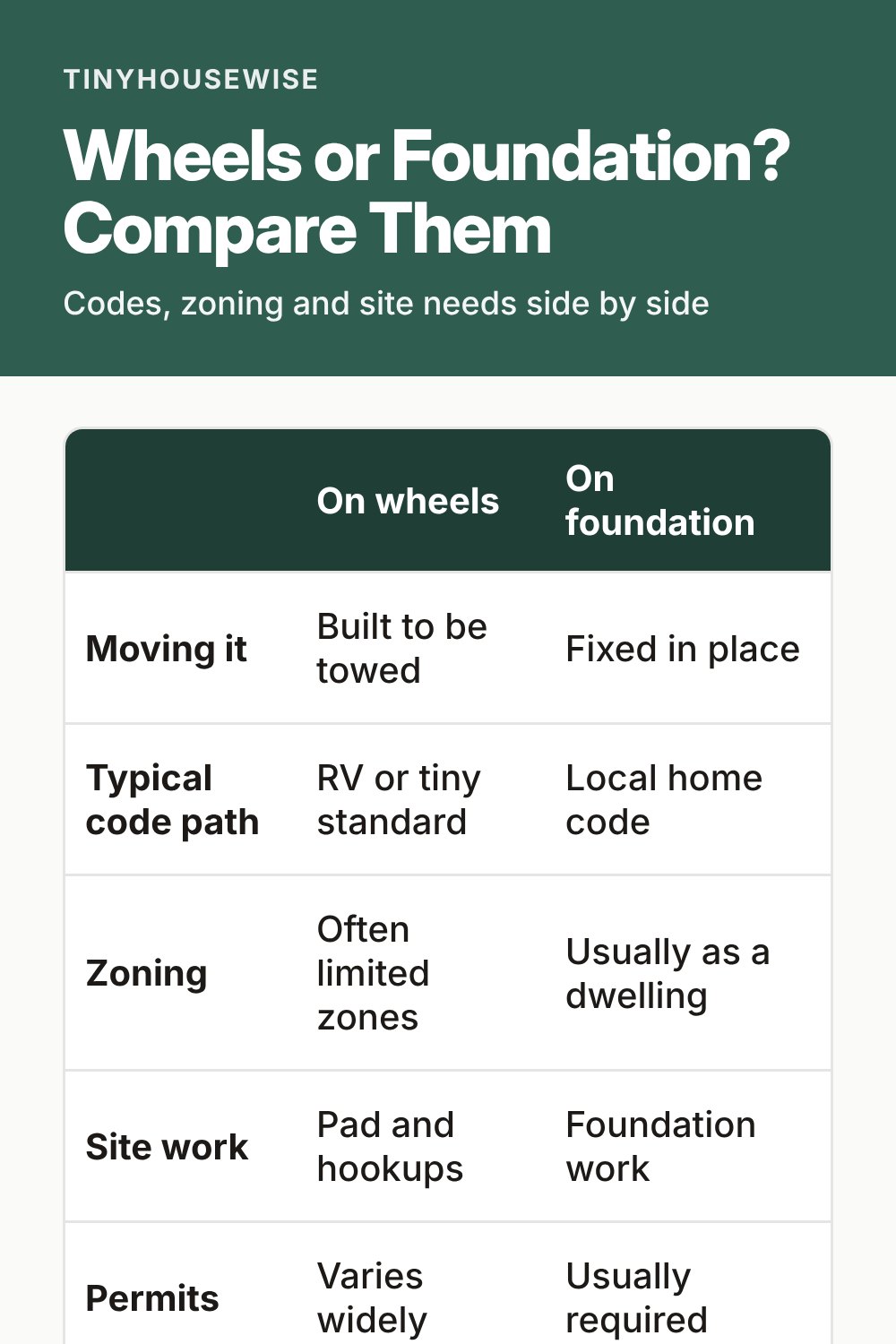
Wheels vs foundation: side-by-side
| Factor | On wheels | On a foundation |
|---|---|---|
| Typical code path | RV or park model standard, a certified tiny house standard, or local rules for movable units | Local residential building code, sometimes with tiny house provisions |
| Zoning | Often limited to certain zones or treated as a temporary or accessory use | Usually treated as a dwelling or accessory dwelling, subject to lot rules |
| Moving it | Built to be towed, with road rules and tow vehicle limits | Fixed in place |
| Site work | Level pad, parking space and hookups | Foundation design, excavation or piers, and inspections |
| Utilities | Often flexible hookups, or self-contained systems | Usually connected to permanent water, sewer or septic, and power |
| Permits | Varies widely; some places have no clear path | Usually a building permit and inspections |
| Long-term use | Depends on local rules for wheeled homes | Generally the more established route |
Use this table as a starting point only. Your local office has the final word on which column applies to your project.
A city example of why local rules matter
The City of Boise, Idaho, shows how specific rules can be. Its page says tiny houses on a foundation must meet the one- and two-family dwelling code, with Appendix Q allowing some relaxed requirements such as lower loft ceilings. Boise also states that tiny houses need to be on a permanent foundation.
For wheeled homes, the city introduced rules effective July 1, 2025. It defines a tiny home on wheels as a transportable accessory structure on a chassis with a hitch and wheels, under 400 square feet. These homes are allowed only in some zoning districts, must have self-contained living functions, and must be certified to a standard such as NOAH+ or another standard the city approves. Recreational vehicles are excluded because they are designed for temporary or seasonal use.
This is one city, and your area may be completely different. The lesson is that you should read your own local definitions before you buy a trailer or plans.
What to check before you decide
Work through these steps in order. They save money because you learn the rules before you commit.
- Find your zoning. Look up the zone for your lot and read the table of allowed uses. Note whether a tiny house, an accessory dwelling or a wheeled home is listed.
- Call the planning and building offices. Ask which definitions apply: dwelling, accessory dwelling, RV, or movable tiny home. Ask whether a permanent foundation is required.
- Ask about minimum sizes and setbacks. Some places set minimum floor areas, minimum widths or distances from property lines that affect a very small house.
- Confirm utilities. Ask whether you can connect to water, sewer or septic and power, or whether self-contained systems are accepted.
- Check the standard or certification. If you buy a wheeled house, ask which standard it was built to and whether your local office accepts it.
- Plan the route and the site. For a wheeled home, check road limits for width, length and height. For a foundation home, check access for equipment and deliveries.
- Ask about insurance and financing. Lenders and insurers often treat wheeled and fixed homes differently. Ask providers directly what they require.
Pros and cons at a glance
On wheels
- Pros: can be moved, can be built off site, and suits people who may relocate.
- Cons: fewer clear legal places to park for full-time living, weight and size limits for towing, and exposure to wind unless anchored.
On a foundation
- Pros: usually fits the standard residential process, and can be set up for permanent utilities.
- Cons: cannot be moved, needs site work and inspections, and requires land you can build on.
Common mistakes
- Buying before checking zoning. A beautiful build is hard to use if your local rules do not allow it where you want it.
- Assuming a tiny house is an RV. Some places exclude RVs from long-term living, and a wheeled tiny house may or may not be classified as one.
- Relying on an online forum for rules. Rules change, and what applies in one city may not apply in yours. Get answers in writing from your local office when you can.
- Skipping the site plan. Setbacks, easements, slopes and utility routes can limit where a small house can go.
- Ignoring weight and size on wheels. Trailer ratings and road rules limit how big and heavy a towed home can be. Check your trailer and tow vehicle documents.
When to call a professional
Talk to a licensed professional when you reach the points where mistakes are costly:
- A local planner or zoning officer for what is allowed on your lot.
- A licensed contractor, architect or engineer for foundation design, structural questions and plans for permit review.
- A licensed electrician and plumber for hookups and inspections.
- An attorney if you are dealing with unclear zoning, covenants or a dispute. This guide is not legal advice.
If you are weighing a backyard home, you may also want to look at how accessory dwelling units work in your area, since rules for those are often written separately from rules for tiny houses.
Sources
 Save
Frequently asked questions
Can I live in a tiny house on wheels year-round?
It depends on where you park it. Many places treat a wheeled home as an RV or a temporary structure, and some only allow it in certain zones, so check with your local planning office before you commit.
Do tiny houses on foundations need building permits?
In most places, yes. A house on a foundation is usually reviewed under the local residential building code, and some areas use special tiny house provisions. Ask your building department which edition applies.
Which is easier to move, wheels or foundation?
A house on wheels is built to be towed, though road rules, size limits and the tow vehicle still matter. A foundation house stays where it is built, unless it is a factory-built unit that is delivered and set on site.
Is a tiny house on wheels an RV?
Not automatically. Some wheeled tiny houses are built to RV standards, while others are not, and local rules decide how each type is treated. The label on the unit and the local definition both matter.